On a typical day, a business owner pays for software from a company in the States, a freelancer in Nairobi receives payment from a client in London, and a merchant in Accra settles an invoice with a supplier in China.
From the outside, these transactions appear straightforward. A payment is initiated, funds are received, and business moves on. But behind each of these actions is a complex system that determines whether that payment arrives in minutes or days, whether it costs a few dollars or significantly more, and whether it goes through at all.
For many businesses operating across borders, these differences are not minor inconveniences. Delays can disrupt supply chains, foreign exchange costs can erode already thin margins, and limited access to global financial networks can restrict growth entirely. What sits beneath all of this is a layer of financial infrastructure that most people rarely think about, yet interacts with every transaction they make.
These systems are known as payment rails. They define how money moves, who can move it, how quickly it settles, and how much it costs to send. Whether a payment is made through a bank transfer, a card network, a mobile wallet, or a blockchain-based system, it ultimately depends on the rails supporting it.
Understanding how these systems work is essential for any business operating in a global economy, and even more critical for developers and companies building financial products that depend on them.
What Are Payment Rails?
Payment rails refer to the underlying systems and networks that enable money to move from one party to another. They include the technologies, institutions, and processes that coordinate how transactions are initiated, processed, verified, and ultimately settled.
When a payment is made, funds are not physically transferred in the way people often imagine. Instead, instructions are sent across networks that update balances between financial institutions, reconcile accounts, and ensure that value is transferred accurately between participants.
Different payment rails operate under different rules and constraints. Some prioritize reach and reliability, others prioritize speed and cost efficiency, and newer systems are designed to offer programmability and global accessibility.
These differences become especially important when transactions extend beyond a single country or financial system.
How Traditional Payment Rails Work
To understand why alternative systems are gaining traction, it is important to examine how existing rails operate and where their limitations arise.
Bank Transfers and Correspondent Banking
Most international payments today rely on correspondent banking networks, which allow financial institutions in different countries to transact with one another through established relationships.
When a business in Nigeria sends money to a supplier in Europe, the transaction does not move directly between the two parties. Instead, it is routed through a chain of intermediary banks that facilitate settlement between institutions that may not have direct relationships.
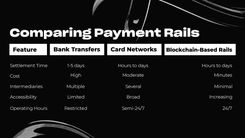
Each intermediary performs a specific function, including verifying compliance requirements, converting currencies, and updating account balances. While this system is well-established and reliable, it introduces multiple layers of cost and delay.
According to the World Bank, cross-border payments in Sub-Saharan Africa remain among the most expensive globally, with remittance costs hovering around 8% of the transaction value
Card Networks
Card payments operate on a different set of rails managed by global networks such as Visa, Mastercard or the likes.
When a customer pays with a card, the transaction is routed through several participants, including the merchant’s bank, the card network, and the issuing bank. Authorization typically happens within seconds, but settlement between institutions occurs later, often in batches.
This model has enabled the growth of global e-commerce, but it comes with processing fees, settlement delays, and dependence on traditional banking systems.
Mobile Money Systems
In many African markets, mobile money platforms have created highly effective domestic payment rails.
These systems allow users to store value, transfer funds locally, and pay for goods and services without requiring traditional bank accounts. While mobile money has significantly improved financial inclusion, its capabilities are often limited when transactions extend beyond national borders.
Where Traditional Systems Fall Short
Traditional payment rails have supported global commerce for decades, but they were not designed for an economy where businesses operate digitally and internationally from the outset.
Cross-border bank transfers can take several days to complete due to multiple intermediaries and time-zone constraints. Costs accumulate at different stages of the transaction process, including foreign exchange spreads and intermediary bank charges, making international payments expensive for many businesses.
Accessibility also remains uneven. Many companies in emerging markets face difficulties accessing global financial systems, particularly when opening international accounts or managing foreign currency transactions.
The Emergence of Modern Payment Rails
As global commerce becomes increasingly digital, new payment rails have begun to emerge to address these structural limitations.
Among the most significant developments is the rise of blockchain-based settlement systems powered by stablecoins.
According to research from Chainalysis, stablecoins now account for approximately 43% of cryptocurrency transaction volume in Sub-Saharan Africa, reflecting their growing role in payments and cross-border transfers. In markets like Nigeria, stablecoin transaction volumes have exceeded $22 billion annually, demonstrating strong real-world adoption beyond trading activity.
Unlike traditional systems that rely on intermediary institutions, blockchain-based rails enable direct value transfer between participants. A typical transaction involves converting local currency into a digital dollar, transferring that value across a blockchain network, and allowing the recipient to receive or convert funds into local currency, because these networks operate continuously, transactions can settle within minutes regardless of geographic location.
Why Payment Rails Matter for Businesses and Developers
For companies operating in a global economy, payment rails directly influence how efficiently a business can function. The choice of rail affects how quickly suppliers can be paid, how easily revenue can be collected from international customers, and how predictable cash flow becomes over time. As expectations shift toward faster and more reliable financial systems, businesses increasingly seek solutions that reduce friction and improve operational efficiency.
For developers and companies building financial products, payment rails define what is possible. Every wallet, exchange, remittance application, or merchant platform ultimately depends on underlying financial systems to move value. The capabilities of those products are shaped by the rails they integrate with, and newer rails introduce speed, programmability, and global accessibility.
Stablecoins are gaining traction because they address practical needs. They enable reliable dollar-denominated transactions, reduce settlement time, and allow financial products to operate across borders without relying entirely on legacy banking infrastructure.
This is the layer Bitnob is focused on building. By providing APIs and infrastructure that simplify access to modern payment rails, developers and businesses are enabled to create financial products that operate seamlessly across global markets.
If you are building for a world where money moves as efficiently as information, explore what Bitnob is building at bitnob.com. or sign up your business on app.bitnob.com