A Nigerian importer trying to pay a supplier in China often faces a familiar sequence of obstacles. Accessing U.S. dollars requires navigating foreign exchange scarcity, bank-imposed limits, and unpredictable pricing. Even after securing funds, completing the transfer may involve multiple intermediary banks, each adding cost and delay. Settlement can take days, sometimes longer, while the underlying business transaction remains on hold.
For freelancers receiving payments from abroad, or families relying on remittances, the experience is not much better. Fees accumulate across payment corridors, and access to global platforms is uneven. In some cases, accounts are restricted, or transactions are delayed without a clear explanation.
These inefficiencies are not edge cases. They reflect structural limitations in how money moves across African markets.
It is within this environment that stablecoins have gained traction, not as speculative instruments, but as practical financial tools. Across the continent, businesses and individuals are increasingly using dollar-pegged digital assets to store value, settle payments, and move money across borders with greater speed and predictability.
According to data from Chainalysis, stablecoins account for roughly 43% of all cryptocurrency transaction volume in Sub-Saharan Africa, signaling a shift toward utility-driven adoption. In Nigeria alone, stablecoin transaction volumes have exceeded $22 billion within a 12-month period, highlighting both scale and real-world usage.
With over $22 billion in stablecoin transactions, Africa is not experimenting at the margins. Stablecoins are transforming payments, enabling businesses to settle faster, pay global suppliers with greater certainty, and operate beyond the constraints of traditional financial systems. The digital dollar is not a future concept in African markets. It is increasingly becoming the standard.
What Stablecoins Represent in the African Context
Stablecoins are digital currencies designed to maintain a stable value, typically by being pegged to fiat currencies such as the U.S. dollar. While their technical structure varies, their relevance in Africa is best understood through function rather than design.
They provide:
- a stable store of value in dollar terms
- a medium for cross-border exchange
- a programmable settlement layer
Globally, dollar-backed stablecoins such as USDT and USDC dominate the market, accounting for the vast majority of circulating supply. In developed markets, where local currencies are stable and financial infrastructure is mature, stablecoins are often positioned as an alternative. In African markets, they are increasingly becoming a replacement layer for missing or inefficient systems.
The Economic Forces Driving Adoption
Stablecoin adoption across African markets is often described as rapid, but speed alone does not explain why it is happening. The more important question is what underlying conditions are making these systems not just attractive, but necessary.
Stablecoin Usage Rises as Local Currencies Weaken
While currency depreciation explains the pressure facing African markets, it does not fully capture how users respond to it in practice. That behavior becomes clearer when we look at transaction data.
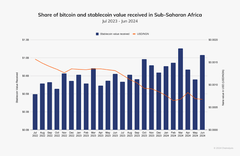
The chart above, based on data from Chainalysis, tracks the share of stablecoin value received in Sub-Saharan Africa between July 2023 and June 2024 alongside the movement of the naira.
What stands out is not just the direction of each trend, but how closely they move in relation to each other. Periods of naira weakness consistently align with increases in stablecoin activity, suggesting that users are actively shifting their financial behavior in response to currency conditions.
This pattern points to something more structural than short-term market interest. Rather than treating stablecoins as speculative assets, users appear to be adopting them as a functional response to instability. When the local currency weakens, stablecoins become a tool for preserving value and maintaining transactional certainty.
The implication is important. Stablecoin adoption in Africa is not simply growing in parallel with economic instability; it is, in many cases, being driven by it. The relationship between the two suggests that stablecoins are filling a gap left by existing financial systems, operating as an alternative layer that users turn to when traditional options become less reliable.
Foreign Exchange Scarcity
In many African markets, businesses cannot freely access U.S. dollars on demand. Central banks often implement controls to manage reserves, which can result in delayed access, rationing, or multiple exchange rates depending on the channel used.
For a business attempting to pay an international supplier, this creates uncertainty at every stage. Pricing becomes unpredictable, timelines become difficult to manage, and transactions may fail altogether due to lack of liquidity.
Estimates suggest that a majority of African economies experience some form of foreign exchange constraint, driven by structural trade imbalances and limited inflows of hard currency.
Stablecoins do not eliminate these macroeconomic realities, but they provide an alternative route around them. By enabling access to dollar-denominated value through digital markets, they reduce dependence on traditional allocation systems and give businesses more control over how and when they transact.
Cost of Cross-Border Payments
The cost of moving money across borders in Africa remains disproportionately high relative to global averages. Traditional cross-border payments rely on correspondent banking networks, where transactions pass through multiple intermediary institutions before reaching their final destination. Each intermediary introduces fees, foreign exchange spreads, and compliance requirements, all of which accumulate along the payment path.
For large transactions, these costs become material. For smaller transactions, particularly remittances, they can be prohibitive.
Stablecoins reduce this complexity by enabling direct settlement on blockchain networks. Instead of passing through multiple institutions, value moves between participants on a shared ledger. While costs are not eliminated entirely, they are significantly reduced, particularly in high-friction corridors.
From Trading Tool to Payment Infrastructure
The early narrative around cryptocurrency adoption in Africa was largely shaped by trading activity. Retail users entered the market seeking exposure to price movements, and much of the infrastructure that emerged was designed to support this behavior. Over time, a different pattern began to emerge.
As stablecoins became more widely available, they started to be used for purposes that extended beyond trading. Individuals began holding them as a hedge against currency depreciation. Businesses started using them to settle cross-border payments. Freelancers adopted them as a way to receive income from international clients without relying on traditional banking systems.
Technologies that are primarily used for speculation tend to experience cyclical adoption. Usage rises and falls with market conditions. By contrast, technologies that solve recurring operational problems tend to become embedded in everyday workflows.
Stablecoins are moving into the latter category. In markets where access to stable currency is limited, where payment systems are slow, and where cross-border transactions are expensive, stablecoins provide a combination of stability, speed, and accessibility that is difficult to replicate with existing infrastructure.
This is why, in several African markets, stablecoins are beginning to account for a larger share of on-chain transaction volume than more volatile assets such as bitcoin. The shift is not ideological. It is functional.
What This Means for Builders
For companies building financial products across Africa, the implications of this shift extend beyond user behavior into product design itself. Every financial product is ultimately constrained by the infrastructure it relies on. If the underlying rails are slow, expensive, or limited in reach, those constraints surface at the user level, regardless of how well the product is designed.
Stablecoins introduce a different set of capabilities. They allow products to settle transactions in minutes rather than days, to operate across borders without requiring correspondent banking relationships, and to provide users with access to stable value in environments where that access is otherwise limited.
However, these capabilities are not automatically accessible. Interacting directly with blockchain systems requires technical expertise, liquidity management, and compliance considerations that most businesses are not equipped to handle independently. This is where infrastructure becomes critical.
Bitnob is building the layer that abstracts this complexity, allowing developers and businesses to integrate stablecoin payments into their products without needing to manage the underlying systems themselves.
Instead of building around the limitations of traditional payment rails, companies can now design products around a different assumption: that money can move globally, quickly, and predictably.
If you are building for that reality, you can explore what Bitnob enables by signing up on app.bitnob.com or visiting our website at bitnob.com.